

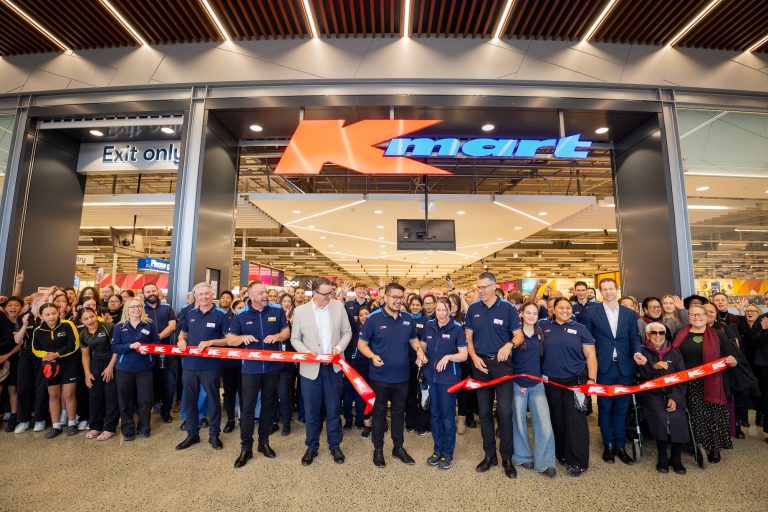
Kmart has opened its biggest ever store in New Zealand, trading 24 hours a day. We may see more of the format in Australia, just not the round-the-clock hours.
Kmart has opened its largest ever New Zealand store, which will trade 24 hours a day — but don’t expect more of this in Australia, experts say.
The 6,700sqm store, which opened last month at Westgate shopping centre around 20km northeast of Auckland, is the company’s third 24-hour store in New Zealand. Australia has 12: six in NSW, four in Victoria and two in Tasmania.
Staff welcoming shoppers into Auckland’s new mega Kmart last month – just don’t expect it in Australia. Picture: Supplied
Retail expert Gary Mortimer at Queensland University of Technology says 24-hour trading only makes sense where there’s genuine overnight demand from the likes of airports, hospitals and shift workers.
“Kmart’s decision to open 24 hours there is quite strange, unless there’s something in the demography that suggests there is a demand out of hours,” he said.
Auckland’s rapidly growing northwest is one of the fastest-growing residential areas in the country, with some light industrial zones and Waitakere Hospital 15 minutes’ drive away. But whether that’s enough for 3am foot traffic is another question.
A Kmart spokesperson said the 24-hour model is “about being where our customers are and continuing to evolve our stores to make shopping easier and more convenient.”

Kiwis are mad for Kmart just like Aussies. Picture: Supplied
Trent Rigby of RC Advisory disagrees it’s a gamble.
“It’s a format they’ve already proven there, not a punt,” he said.
He points to three reasons 24-hour stores are more viable in New Zealand than in Australia.
The first is bigger catchments.
“Australia has roughly 244 for 27.8m people, about one per 114,000; New Zealand runs one per 191,000 — close to 70% more catchment, so a bigger box and a night shift are far easier to justify.”

New Zealand has fewer Kmarts per capita so a big 24-hour one in a growth area might make more sense. Picture: Supplied
Second, New Zealand has looser rules around extended trading hours, while WA, SA and Queensland all restrict night trading in Australia.
“So roughly a third of the country lives where this can’t happen at all,” Mr Rigby said.
Third, overnight wages cost less over the ditch.
Australia’s Retail Award pushes overnight pay to 125%+ for shifts and up to 200% for overtime, while New Zealand has no such loadings at all. An overnight hour costs roughly A$36 here versus around A$19 there — based on the minimum wage of NZ$23.95 — about 85% more.

Different labour and commercial property conditions can make the size of Auckland’s new 24-hour Kmart more feasible. Picture: Supplied
That’s before security, lighting and mall-access costs are even added.
“Overnight remains the hardest shift to staff safely and the dearest to secure,” said Mr Rigby.
Bigger stores, wider ranges
As for the round-the-clock hours, Mr Mortimer says 24-hour retail hasn’t disappeared in Australia so much as moved online — but that’s not necessarily good news for retailers.
“Operationally, it’s cheaper for a customer to come to your store, have a great experience, touch and feel the product, and buy it there and take it away themselves than have them sit at home, see something online, have it delivered to their house. It’s costly to do that last mile.”

‘Destination retail’ is keeping bricks and mortar alive and getting shoppers through the door. Picture: Supplied
Instead, discounters are chasing foot traffic by creating an experience worth leaving the couch for.
That’s where the size of Kmart Westgate comes in — sort of.
At 6,700sqm it’s Kmart’s biggest yet in New Zealand, but Mr Mortimer says it’s nothing unusual for Australia, where big-box retail is already all about going bigger.
“You only need to look at the likes of IKEA, Costco, Bunnings, Anaconda. These big box retailers are very much about becoming a destination and they’re strategically planned to help you spend a few hours there.
“If you’re a Bunnings, grab a snag. If you’re IKEA, grab breakfast and spend half a day wandering the store.”

Kmart is unrolling its new Plan C strategy set to steamline its processes. Picture: Supplied
Expect more of the same locally, he says — bigger stores, wider ranges, minus the graveyard shift.
Kmart’s Plan C+ format — already in around 20 Australian stores — is part of that push, offering what the spokesperson described as “larger and more intuitive departments, improved product presentation, expanded self-service checkouts, and more efficient back-of-house operations”.
This tech-heavy layout runs on fewer staff, which is exactly what makes a night shift affordable in the first place, Mr Rigby says.
“That format is what makes a night shift survivable,” he says. “Expect Plan C+ to keep rolling out in Australia and closing times to creep later in a small number of growth corridors.”
The latest commercial property news
Get the latest news and insights straight to you.