


A few years ago, you could get away with a gut check. Rents were climbing fast, home prices felt manageable next to where they’d end up, and a “pretty good” property usually turned into a decent investment anyway. That margin for error is gone.
Home prices are sitting near record highs, mortgage rates are still parked in the mid 6% range, and the days of assuming a property will simply work themselves out are over. If you’re buying a home with the intention of renting it out, whether that’s a long-term lease or a short-term Airbnb, you need to run real numbers before you make an offer, not after you’ve closed.
We asked Chen Zhao, Redfin‘s Head of Economics Research, what buyers get wrong when they evaluate a potential rental property today. Her answers, along with the actual metrics you should calculate before you buy, are below.
Key Takeaways
- Home prices and mortgage rates have both stayed elevated in 2026, which means rental income has to work harder to justify a purchase than it did a few years ago.
- Cash flow, cap rate, and cash on cash return are the three numbers that tell you whether a property actually pencils out, not just whether it feels like a good deal.
- Rental demand signals, like vacancy rates, rent growth, job growth, and new apartment supply, matter as much as the price of the home itself.
- The most common mistake buyers make is underestimating ongoing costs and assuming best-case occupancy from day one.
- Whether you lean toward a short-term or long-term rental strategy, the same underlying data should inform the decision, not a coin flip.
Why Buying a Rental Property Today Takes More Than a Gut Check
The math has genuinely gotten harder. The average 30-year fixed mortgage rate has been sitting in the mid 6% range through the summer of 2026, and national home prices have kept climbing even as sales have cooled. Existing home sales actually pulled back through the first half of the year as buyers ran into affordability walls, according to National Association of Realtors data.
That combination, higher prices and higher borrowing costs, means monthly ownership expenses have grown faster than rents in a lot of markets. If you’re financing the purchase, you can’t lean on the old assumption that rent will comfortably cover your mortgage payment with room to spare.
We asked Chen Zhao directly what’s changed. Here’s how she broke it down.
Mashvisor: How should buyers think about the relationship between home prices, mortgage rates, and achievable rental income in today’s market?
Zhao: The math is more challenging than it was a few years ago because the market is more volatile. High home prices and elevated mortgage rates have pushed monthly ownership costs up much faster than rents in many markets. Buyers shouldn’t assume rent will fully cover their mortgage payment, taxes, insurance, maintenance, and vacancies, especially if they’re financing the purchase and if economic uncertainty continues. A rental property should make sense based on realistic income projections, not the expectation that rents or home values will climb quickly.
Her point is straightforward: rent alone often isn’t enough anymore. A rental only makes sense based on realistic income projections, not a bet that rents or home values will climb quickly to bail out the deal.
That covers the cost side of the equation. On the demand side, Zhao pointed to a different set of signals.
Mashvisor: From Redfin’s perspective, what market conditions should buyers pay the closest attention to before purchasing a home they may use as a rental property?
Zhao: Buyers should look beyond home prices and pay close attention to the local balance between purchase supply and rental demand. In many markets, there are more homes for sale than buyers, giving purchasers more negotiating power. But that doesn’t necessarily mean a property will make a good rental. Look at vacancy rates, rent growth, new apartment construction, the local job market, and migration patterns. Areas with diverse employers and steady population growth tend to have more resilient rental demand over the long run.
That last point is worth sitting with. A market can look like a buyer’s dream on the surface, with plenty of inventory, motivated sellers, room to negotiate, and still be a mediocre place to own a rental if the underlying demand isn’t there. Negotiating leverage on the purchase doesn’t transfer into rental performance. Those are two separate questions, and Zhao’s answer treats them that way.
That’s exactly why running the actual numbers matters more now than it did during the low-rate years. Let’s get into what those numbers are.
The Core Numbers Every Buyer Should Calculate
Before you get attached to a property, run it through these metrics. None of them require a finance degree, but skipping them is how buyers end up with a property that looks good on paper and bleeds cash in real life.
Cash flow: This is your rental income minus every expense tied to the property, including the mortgage payment. If cash flow is negative, you’re paying to own the property every month and betting on appreciation to make up the difference. That’s a riskier bet than it used to be given how much prices have already run up.
Net operating income (NOI): Your rental income minus operating expenses, not including the mortgage. This number tells you how the property performs independent of how you financed it, which makes it useful for comparing two different properties or two different markets.
Cap rate: NOI divided by the property’s price or current value. A lower cap rate generally means lower risk and a longer payback period, while a higher cap rate usually signals more risk or a less competitive market. Cap rate is especially useful when you’re comparing similar property types across different cities.
Cash on cash return (CoC): Your annual pre-tax cash flow divided by the total cash you put into the deal, including your down payment and closing costs. This is the number that tells you how hard your actual invested dollars are working, and it’s the one most buyers care about most because it reflects real out-of-pocket return.
Vacancy rate: The percentage of time the property sits unrented. Even a strong rental market has some vacancy built in between tenants or bookings, and if you don’t build a cushion for it into your projections, a slow month or two will wreck your annual numbers.
Total expenses: Property taxes, insurance, HOA fees if applicable, routine maintenance, capital expenditures for bigger repairs down the road, and property management if you’re not self-managing. Buyers consistently underestimate this line item, which is a mistake we’ll come back to.
Mortgage costs: Principal, interest, and how your rate compares to current market averages. With 30-year rates still elevated, even a half-point difference in your rate can swing your monthly cash flow by a meaningful amount.
Running these numbers on Mashvisor’s rental property calculator takes minutes instead of hours, and it pulls comparable rent and price data automatically instead of asking you to estimate blind. For a deeper breakdown of how each of these metrics is calculated, our guide on key metrics to know before buying investment property walks through the formulas in more detail.
Ready to see how a specific property pencils out? Start analyzing properties and get cash flow, cap rate, and cash on cash return calculated automatically.
Market Signals Buyers Should Evaluate Before Making an Offer
The numbers on a single property only tell part of the story. You also need to understand the market that property sits in, because the same house can be a great rental in one city and a mediocre one in the next town over.
Zhao already flagged the core signals above: vacancy rates, rent growth, new apartment construction, the local job market, and migration patterns. Here’s how each one actually plays out.
A few signals worth tracking market by market:
Rental demand and rent growth: Single-family rent growth picked up during the spring 2026 leasing season, though the pace has varied a lot by metro. Markets with tight rental supply and steady job growth tend to support stronger rent growth over time, while markets getting flooded with new apartment supply, especially in parts of the Sun Belt, have seen rent growth cool off as competition increases.
New apartment construction: A wave of new apartment supply can suppress rent growth in a market even if the population is growing, because renters suddenly have more options. Before buying, check whether the local market has a lot of new multifamily construction in the pipeline.
Job market and migration trends: This is where Zhao’s framing does the most work. A market with a diverse mix of employers (healthcare, tech, education, manufacturing) rather than a single dominant industry, tends to hold up better when one sector slows down. Pair that with steady population growth and you get rental demand that doesn’t evaporate the moment one employer has a bad year.
On migration specifically, markets seeing an influx of new residents tend to have stronger long-term rental demand, while destinations that draw tourists or remote workers can be better suited to short-term rental strategies. The distinction matters because it points you toward which rental strategy fits the market you’re looking at, not just whether the market is “hot.”
Home price relative to rent: If home prices are high relative to what a property can realistically rent for, the numbers get harder to make work as a landlord. This is worth checking before you fall in love with a listing, not after.
Local STR regulations: If you’re considering a short-term rental strategy, check local short-term rental laws before you buy, not after. Some cities have de facto bans or heavy permitting requirements that can eliminate an Airbnb strategy entirely. Mashvisor’s short-term rental regulations tool breaks down the rules market by market so you’re not finding out the hard way.
Comparing markets manually across all of these signals is slow, which is part of why platforms like Mashvisor exist. Mashvisor combines rental comps, cap rate data, and neighborhood-level analytics in one place so you can compare multiple markets side by side instead of researching each one from scratch.
Common Financial Mistakes Buyers Make
Even experienced buyers get tripped up on the same handful of mistakes when they’re evaluating a rental purchase. We asked Zhao directly what she sees most often.
Mashvisor: What are some common financial mistakes buyers make when evaluating whether a property could work as a rental?
Zhao: One of the biggest mistakes is underestimating ongoing costs. Maintenance, repairs, insurance, property taxes, vacancy periods, and property management expenses all add up. Another is basing projections on best-case scenarios, like assuming the property will always be occupied or that rents will keep climbing. Buyers should build in a cushion for unexpected expenses and periods without rental income, especially as consumers become more strapped for cash. If the numbers only work under perfect conditions, it’s probably not a good investment. Pricing realistically and budgeting conservatively are key.
That “consumers become more strapped for cash” line is worth pulling out on its own. It’s not just about your own budget cushion, it’s a reminder that your tenants or guests are under the same financial pressure you are. A tighter-budgeted renter is more likely to fall behind or move out early, and a guest watching their own spending is more likely to shop around for a cheaper stay. Both push your actual occupancy below whatever number looked good in your spreadsheet.
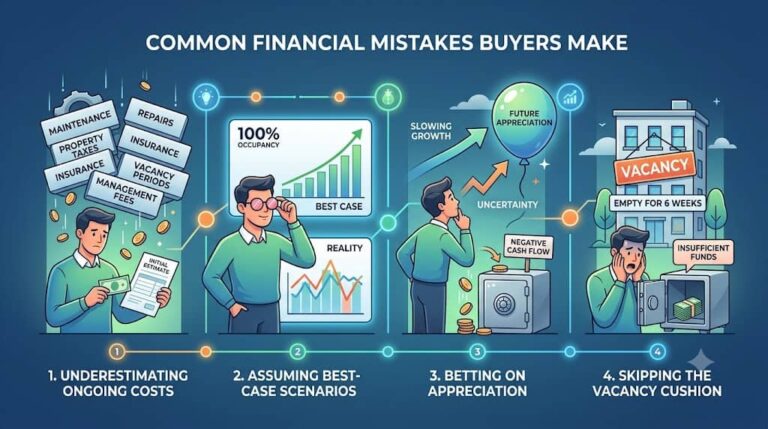
Underestimating ongoing costs. Maintenance, repairs, insurance, property taxes, vacancy periods, and property management fees all add up fast, and buyers routinely lowball this line item because it’s easier to focus on the purchase price and expected rent.
Projecting best-case scenarios. Assuming a property will be occupied 100% of the time, or that rents will keep climbing every year, is a good way to end up with a deal that only works under perfect conditions. Price conservatively and budget for the months that don’t go perfectly.
Betting on appreciation instead of cash flow. It’s tempting to justify a thin or negative cash flow property by assuming the home value will keep climbing. With price growth slowing nationally compared to a few years ago, that bet carries more risk than it used to. A property should make sense based on the income it generates, not a hoped-for future sale price.
Skipping the vacancy and expense cushion. Even strong rental markets have turnover between tenants or gaps between bookings. Buyers who model 12 months of full occupancy every year are setting themselves up for a rude awakening the first time a unit sits empty for six weeks.
Short-Term vs. Long-Term Rental: Using the Same Data to Decide Both Ways
Once the core numbers check out, you still have to decide what kind of rental you’re actually running. This isn’t a coin flip, and it isn’t about which strategy sounds more exciting. The same market data that tells you whether to buy should also tell you which rental strategy fits the property.
Signals that favor a short-term rental strategy: Strong and growing tourism demand, rising nightly rates, low short-term rental supply relative to demand, and a local regulatory environment that actually allows STRs to operate without heavy restriction. Tourism-driven destinations with year-round appeal, strong shoulder seasons, or growing visitor numbers tend to support higher short-term yields. Zhao adds that markets seeing tourist or remote worker growth can outperform with a short-term strategy, provided you’re managing the property professionally and pricing dynamically rather than treating it as passive income.
Signals that favor a long-term rental strategy: Tight for-sale housing supply, rising rent costs, strong local job growth, and steady population inflows all point toward long-term renting. If you’re seeing an increase in short-term listings flooding a market, or stricter local STR regulations taking hold in places like New York City or Honolulu, that combination compresses short-term returns and tilts the math back toward a traditional lease.
How the economy factors in: We asked Zhao how broader economic conditions, interest rates, affordability, and migration shape this decision.
Mashvisor: How do broader economic factors influence the decision between short-term and long-term rentals?
Zhao: Higher interest rates raise the cost of ownership, which puts pressure on both strategies, but especially on short-term rentals where income can be less predictable. Affordability constraints can push more households into renting, which supports long-term rental demand. Migration trends also matter. Markets that are seeing an influx of new residents tend to have stronger long-term rental demand, while destinations that attract tourists or remote workers may be better suited for short-term rentals. Today, where costs are high and the economy is uncertain, many investors are prioritizing the stability of long-term renting over maximizing short-term returns.
That’s a notable signal on its own. When Redfin’s own Head of Economics Research says investors are broadly favoring stability over upside right now, it’s not a reason to rule out short-term rentals everywhere, but it is a reason to hold your STR projections to a higher standard of proof before you commit to that strategy over a long-term lease.
If you’re weighing the two strategies for a specific property, our full breakdown on short-term vs. long-term rentals walks through how regulations, costs, and management effort have shifted for both sides heading into 2026.
How Mashvisor Helps You Compare the Numbers Before You Commit
Every metric covered above (cash flow, cap rate, cash on cash return, vacancy, and rent comps) is available through Mashvisor’s investment property tools without you having to build a spreadsheet from scratch. You can search a market, pull rental comps for both short-term and long-term strategies, and see projected returns for a specific address before you ever make an offer.
That matters because the buyers getting burned right now aren’t the ones who ran the numbers and got unlucky. They’re the ones who skipped the numbers entirely and relied on the same best-case assumptions Zhao warned against. Having a reliable source that layers LTR and STR data together will help you make the most sound financial decisions.
Run the numbers on a property before you make an offer, and see exactly how it performs as both a short-term and long-term rental.
The Bottom Line
Buying a rental property investment in 2026 requires more discipline than it did a few years ago. Home prices are near record highs, mortgage rates aren’t dropping fast, and the properties that used to work on optimism alone don’t work anymore. Run your cash flow, cap rate, and cash on cash return before you get emotionally attached to a listing. Check the local job market, migration trends, and rental supply, not just the sale price. Budget conservatively for expenses and vacancy instead of assuming everything goes right. And when you’re deciding between a short-term or long-term strategy, let the same data guide both sides of that decision instead of picking based on which one sounds more fun.
The buyers who do well in this market aren’t the ones with the biggest risk appetite. They’re the ones doing the math before they sign anything.
FAQs
What numbers should I calculate before buying a rental property?
You should calculate cash flow, net operating income, cap rate, cash on cash return, vacancy rate, total operating expenses, and your expected mortgage cost before buying a rental property. These numbers together tell you whether the property will actually generate positive returns rather than just looking good on paper.
Why is it harder to buy a rental property in 2026 than a few years ago?
Home prices remain near record highs while mortgage rates have stayed in the mid 6% range through 2026, which means monthly ownership costs have risen faster than rents in many markets. That makes it harder for rental income alone to cover the full cost of ownership, so buyers need more conservative, realistic projections than they did during the lower rate years.
What’s a good cash on cash return for a rental property?
Many investors consider a cash on cash return between 8% and 12% to be a solid benchmark, though the right number depends on your market, risk tolerance, and financing terms. A lower return can still be worthwhile in a stable, low-risk market, while a higher return may come with more volatility or management demands.
Should I buy a short-term or long-term rental property?
The right choice depends on local market signals rather than personal preference alone. Strong tourism demand, rising nightly rates, and light STR regulation tend to favor short-term rentals, while tight for-sale supply, strong job growth, and rising rents tend to favor long-term rentals. Reviewing both sides with the same market data helps you make a decision grounded in numbers instead of assumptions.
What’s the biggest mistake buyers make when evaluating a rental property?
The most common mistake is underestimating ongoing costs and assuming best-case occupancy from day one. Buyers who don’t build in a cushion for maintenance, vacancy, and unexpected expenses often end up with a property that only performs well under perfect conditions, which rarely happens in practice.
How do I check if my market favors long-term or short-term rentals right now?
Look at vacancy rates, rent growth, new apartment construction, job growth, and migration trends for long-term rental potential, and tourism demand, nightly rate trends, and local STR regulations for short-term rental potential. Tools like Mashvisor’s Market Finder can give you an overview rating for a specific market so you don’t have to research each signal manually. Learn more about how this rating works.